 If you have ever stepped outside with a cup of tea, settled into your favourite garden chair, and then immediately been joined by a wasp with absolutely no respect for personal space, this is one of those crochet projects that suddenly makes perfect sense.
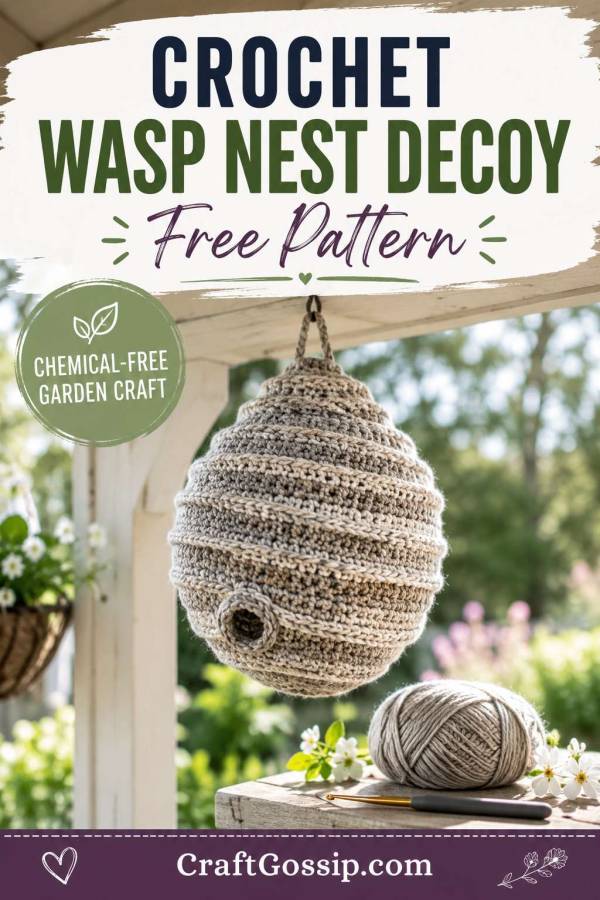
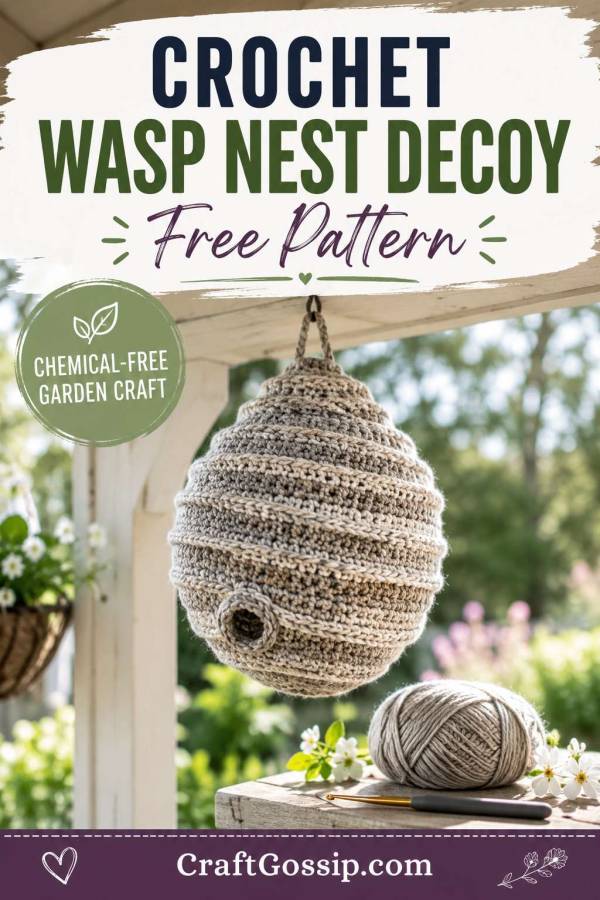
A crochet wasp nest decoy is a handmade faux nest designed to look like an already-established paper wasp or hornet-style nest. The idea is simple: some wasps are territorial, so a decoy may encourage them to choose another spot before they begin building nearby. Is it guaranteed? No. Nature rarely reads the craft blog before making decisions. But it is a clever, low-cost, chemical-free project to try, especially in early spring before wasps start settling into their favourite nesting spaces.
This version has been designed as an original crochet pattern with soft ridges, a slightly tapered oval shape, and a natural nest-like texture. It uses basic stitches, works up quickly, and is a great stash-busting project for leftover tan, grey, oatmeal, beige, mushroom, or light brown yarn.
Use it near a porch, patio, garden shed, chicken coop, outdoor dining area, kids’ play space, or anywhere you want to gently discourage wasps from setting up too close for comfort.
Before You Start
A crochet wasp nest decoy is best used as a preventative craft, not as a solution for an active nest. If you already have wasps nesting near a doorway, roofline, wall cavity, or high-traffic area, it is safer to contact a pest professional, especially if anyone in the household has allergies to stings.
This decoy is simply one extra thing to try alongside sensible outdoor habits like keeping bins closed, cleaning up sweet drinks and food scraps, sealing tiny outdoor gaps, and checking eaves early in the season.
Materials
- Worsted weight acrylic yarn in beige, grey, tan, oatmeal, mushroom, or light brown
- 5mm crochet hook
- Stitch marker
- Yarn needle
- Scissors
- Polyester stuffing, yarn scraps, or lightweight recycled plastic bags
- Optional: scrap of darker yarn for a few irregular surface lines
- Optional: clear fishing line, garden twine, or a strong yarn loop for hanging
Yarn Notes
Acrylic yarn is a practical choice because it handles outdoor humidity better than wool and dries more quickly than cotton. If your decoy will be exposed to rain, hang it somewhere sheltered, such as under an eave, veranda roof, pergola, or covered patio.
For a more realistic look, use a slightly heathered or variegated neutral yarn. Real wasp nests are not perfectly one colour, so soft colour changes can make the finished decoy look more natural.
Skill Level
Easy / confident beginner
You should know how to work in the round, increase, decrease, and keep track of stitch counts.
Finished Size
Approx. 7–9 inches tall, depending on yarn, hook size, and stuffing.
Abbreviations – US Terms
- MR – magic ring
- ch – chain
- sl st – slip stitch
- sc – single crochet
- hdc – half double crochet
- dc – double crochet
- inc – increase, work 2 stitches into the same stitch
- dec – decrease, crochet 2 stitches together
- BLO – back loop only
- st/sts – stitch/stitches
Pattern Notes
This pattern is worked in continuous rounds unless stated otherwise. Do not join at the end of each round. Place a stitch marker in the first stitch of each round and move it up as you go.
The BLO rounds create subtle horizontal ridges to mimic the layered paper look of a wasp nest. Stuff lightly as you work. The shape should look a little organic, not like a perfectly firm ball.
Top of Nest
Round 1: Work 6 sc into MR. (6)
Round 2: Inc in each st around. (12)
Round 3: Sc in next st, inc in next st, repeat around. (18)
Round 4: Working in BLO, sc around. (18)
Round 5: Sc in next 2 sts, inc in next st, repeat around. (24)
Round 6: Working in BLO, hdc around. (24)
Building the Body
Round 7: Hdc in next 3 sts, inc in next st, repeat around. (30)
Round 8: Working in BLO, hdc around. (30)
Round 9: Hdc in next 4 sts, inc in next st, repeat around. (36)
Round 10: Working in BLO, hdc around. (36)
Round 11: Hdc in next 5 sts, inc in next st, repeat around. (42)
Round 12: Working in BLO, hdc around. (42)
Round 13: Hdc in next 6 sts, inc in next st, repeat around. (48)
Round 14: Working in BLO, hdc around. (48)
Widest Section
Round 15: Hdc around. (48)
Round 16: Working in BLO, hdc around. (48)
Round 17: Hdc around. (48)
Round 18: Working in BLO, hdc around. (48)
At this point, your piece should look like a rounded dome with soft ridges. Start adding light stuffing. Do not overstuff, as a slightly uneven shape looks more natural.
Tapering the Nest
Round 19: Hdc in next 6 sts, dec, repeat around. (42)
Round 20: Working in BLO, hdc around. (42)
Round 21: Hdc in next 5 sts, dec, repeat around. (36)
Round 22: Working in BLO, hdc around. (36)
Round 23: Hdc in next 4 sts, dec, repeat around. (30)
Round 24: Working in BLO, hdc around. (30)
Round 25: Hdc in next 3 sts, dec, repeat around. (24)
Add more stuffing now, shaping the nest into a tapered oval. You want it plump but not hard.
Round 26: Working in BLO, hdc around. (24)
Round 27: Hdc in next 2 sts, dec, repeat around. (18)
Round 28: Hdc around. (18)
Round 29: Hdc in next st, dec, repeat around. (12)
Round 30: Dec around. (6)
Fasten off, leaving a long tail. Thread the tail through the front loops of the remaining stitches, pull closed, and weave in securely.
Hanging Loop
Join yarn at the top centre of the nest.
Option 1: Simple chain loop
Ch 20–30, depending on how long you want the hanger. Sl st back into the same top stitch. Fasten off and weave in the ends.
Option 2: Stronger outdoor loop
Use garden twine, clear fishing line, or doubled yarn. Thread it through the top of the decoy and knot securely.
Optional Surface Texture
For a more natural paper-nest look, use a slightly darker yarn and add a few loose, irregular surface lines.
Thread a yarn needle with a 12–18 inch length of darker yarn. Weave it gently around the body in uneven horizontal curves, following the crochet ridges. Do not make the lines too neat. Real nests have soft, wavy striping rather than perfect rings.
You can also hold two neutral yarns together for a mottled, rustic look.
Where To Hang A Crochet Wasp Nest Decoy
Hang your decoy somewhere visible but sheltered, ideally before wasps start nesting for the season.
Good places to try include:
- Under porch eaves
- Near patio seating
- Under a pergola
- Beside a shed door
- Near an outdoor dining area
- Close to a playhouse or swing set
- Near a chicken coop or garden workbench
Avoid placing it directly in heavy rain or somewhere it will stay damp. If it becomes soaked, bring it inside, squeeze out excess moisture gently, and let it dry completely before rehanging.
When To Use It
The best time to hang a wasp nest decoy is early in the warm season, before wasps have chosen a nesting site. Once a real nest is already active, a decoy is unlikely to make the colony leave.
For seasonal use, hang it in spring and check it every few weeks. Replace or refresh it if it becomes faded, flattened, or weather-damaged.
Does A Crochet Wasp Nest Decoy Really Work?
A crochet wasp nest decoy is one of those garden ideas that many crafters love because it is simple, inexpensive, and chemical-free. Some people swear by them. Others find they make no difference at all.
The honest answer is that results can vary. Different wasp species behave differently, and some do not build the kind of hanging paper nests this project is meant to mimic. Ground-nesting wasps, for example, are not likely to care about a hanging crochet decoy.
That said, it is still a charming and practical garden craft to try. At worst, you have made a quirky handmade outdoor decoration. At best, it may help encourage wasps to choose a different spot before they settle too close to your porch, patio, or garden seat.
Safety Note
Never disturb an active wasp nest, especially if it is large, hidden inside a wall, near a doorway, or close to children or pets. If you are allergic to wasp stings or unsure what kind of nest you are dealing with, call a professional pest control service.
This crochet decoy is intended as a preventative craft only.
Final Crochet Tips
For the most realistic finish, choose muted natural colours rather than bright yellow or white. Wasps’ paper nests often look grey, beige, tan, or brownish, so soft earthy yarns work best.
If you are making several decoys, vary the sizes slightly. Real nests are not identical, and a group of handmade versions can look more natural when they are not perfectly matched.
This is also a great market-stall crochet item for spring and summer craft fairs. Add a little tag explaining that it is a handmade wasp nest decoy to try as a chemical-free garden deterrent, and remind buyers that it is not a guaranteed pest-control product.