Are Moroccan Leather Poufs Worth It? What to Look For
A genuine Moroccan leather pouf is one of the few home accessories that improves with age — but only if you buy the right one. For this reason, it’s worth knowing exactly what separates a worthwhile investment from a disappointing imitation.
Are Moroccan Poufs Worth the Money?
What makes a genuine Moroccan pouf different from a cheap imitation?
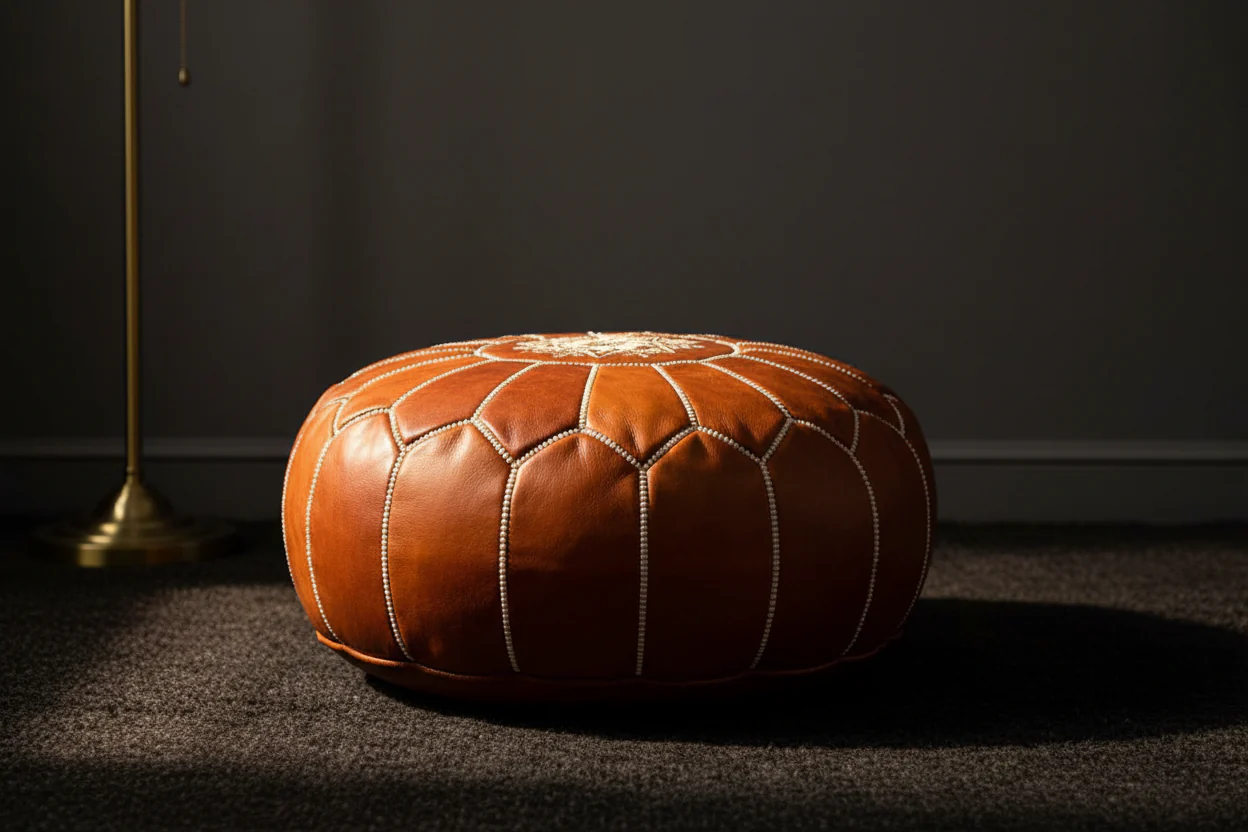
Hand-stitched by a single artisan over 20 to 36 hours, a genuine Moroccan pouf uses full-grain goatskin leather tanned in centuries-old medina tanneries. Every seam, every panel, every lacing hole is placed by hand. Cheap imitations, by contrast, are machine-cut, machine-stitched, and often made from split leather or bonded leather — materials that crack, peel, and flatten within months.
The difference isn’t just aesthetic. It’s structural. The real thing holds its shape for decades, whereas a fake one rarely survives two years of daily use.
How long does a real Moroccan leather pouf last?
With minimal care, a well-made Moroccan leather pouf lasts 15 to 30 years. Over time, the leather develops a rich patina (the natural darkening and softening of aged leather) — becoming more beautiful with use. This is the hallmark of full-grain leather: it ages forward, not backward.
What to Look For When Buying a Moroccan Pouf
Leather quality — full-grain vs split leather
First and foremost, check the leather quality — this is where most cheap poufs cut corners. Full-grain leather retains the natural surface of the hide — grain, texture, and all. It is the strongest, most durable layer. Split leather, on the other hand, is the underside of the hide, sanded smooth and coated to look like full-grain. It feels uniform, almost plastic-like, and has none of the breathability or longevity of full-grain.
How to tell: Press your thumb into the surface. Full-grain leather will show a slight, natural impression and spring back slowly. Split leather feels stiff or rubbery.
Hand-stitching vs machine-made: how to tell the difference
Beyond the leather itself, the stitching tells you everything about how a pouf was made. Hand-stitching is slightly irregular — consistent in tension but not robotically uniform. Each stitch is placed with intention. Machine stitching, however, is perfectly even, often too tight, and leaves no room for the leather to breathe and move naturally.
Look at the seams along the panels and the lacing around the base. On a genuine pouf, you will see the artisan’s hand in every line.
Filling matters: wool, cotton, or foam?
Equally important is what’s inside. Traditional Moroccan poufs are filled with natural materials — shredded wool offcuts, cotton fabric scraps, or dried natural fibers. These materials compress naturally, hold shape over time, and are breathable.
Foam filling is a red flag. It degrades, loses density, and creates an unnatural bounce that feels nothing like the firm, grounded feel of a properly filled traditional pouf.
Weight and density as quality indicators
Finally, use weight as a quick quality check. Pick it up. A well-filled, full-grain leather pouf should feel substantial — not heavy, but dense and grounded. A light, hollow-feeling pouf signals poor filling or thin leather.
Red Flags to Avoid
Synthetic leather disguised as genuine
PU leather and bonded leather are increasingly common in cheap poufs marketed as “genuine leather.” Look for the words full-grain, goatskin, or genuine Moroccan leather — and ask the seller directly where the leather is sourced and tanned.
Machine embroidery vs hand embroidery
On embroidered poufs, machine embroidery sits flat and uniform on the surface. Hand embroidery, in contrast, has slight dimensional variation — threads cross at natural angles, colours blend at the edges, and the pattern has a living quality that no machine replicates.
Suspiciously low prices — what they hide
Artisans spend 20 to 36 hours hand-stitching a genuine Moroccan leather pouf. As a result, a price below £50–65 for a standard round pouf almost always means compromised materials, machine production, or exploitative labour conditions. Authentic craft has a cost — and it is worth it.
Where Are the Best Moroccan Poufs Made?
Fès, Marrakesh, Tétouan — regional differences
Fès is Morocco’s leather capital — home to the famous Chouara tannery and centuries of leather craft tradition. Moreover, Fès poufs tend to use the finest goatskin, with precise geometric gold stamping.
Marrakesh produces more decorative, colourful pieces — bold embroidery, vibrant dyes, and high tourist-market volume. However, quality varies widely, so it pays to be selective.
Tétouan, in northern Morocco, is less known internationally. Nevertheless, it produces some of the most refined, understated leather work — closer to Andalusian craft traditions, with exceptional embossing precision.
Why buying direct from artisans matters
When you buy through intermediaries (middlemen between the artisan and the buyer) and import platforms, quality control disappears. Buying directly from a brand with established artisan relationships means traceability — you know who made your pouf, where, and how.
How to Care for a Moroccan Leather Pouf
Conditioning, cleaning, and patina over time
- Condition every 6–12 months with a natural leather conditioner (beeswax or lanolin-based). Avoid silicone products, as these clog the leather’s pores.
- Clean spills immediately with a dry cloth. For deeper cleaning, use a damp cloth with a drop of mild soap — never saturate the leather.
- Rotate the pouf occasionally to ensure even wear and filling distribution.
- Embrace the patina — darkening and softening over time is not wear, it is character. A well-aged Moroccan leather pouf is more beautiful at year ten than at year one.
Frequently Asked Questions
Are Moroccan poufs good quality? Genuine hand-stitched Moroccan leather poufs made from full-grain goatskin are exceptional quality — durable, beautiful, and built to last decades. However, quality varies significantly between authentic artisan-made pieces and mass-produced imitations.
How do I know if a Moroccan pouf is real leather? Check for natural grain variation, slight irregularity in stitching, and a genuine leather smell. In addition, ask the seller for the leather type — full-grain goatskin is the standard for authentic Moroccan poufs — and the country of manufacture.
Are Moroccan poufs comfortable to sit on? Yes — when properly filled with natural materials, a Moroccan leather pouf provides firm, supportive seating. It is not a cushion; it is closer to a low stool. As a result, it works well as a footrest, extra seat, or side table.
Buying, Filling and Longevity
Do Moroccan poufs need to be filled? Most authentic Moroccan poufs are shipped unfilled to reduce costs and weight. They arrive flat and need to be filled with shredded fabric, wool, or old clothing. That said, some sellers offer pre-filled options.
How long do Moroccan leather poufs last? A genuine full-grain leather Moroccan pouf lasts 15 to 30 years with basic care. Furthermore, the leather improves with age, developing a rich patina that makes each piece unique over time.
What is the best filling for a Moroccan pouf? Shredded wool, cotton fabric scraps, or old clothing are the traditional and best options. They compress naturally, hold shape, and are breathable. Above all, avoid foam — it degrades quickly and creates an unnatural feel.
Are cheap Moroccan poufs worth buying? No. Below a certain price point, you are buying split leather or synthetic leather with machine stitching and foam filling — none of the durability, beauty, or craft of a genuine piece. It is always better to invest in one authentic pouf than to replace three cheap ones.
At Artezana, every pouf in our collection is sourced directly from skilled artisans in Fès, Marrakesh and Tétouan — no intermediaries, no compromises. Explore our Moroccan pouf collection →