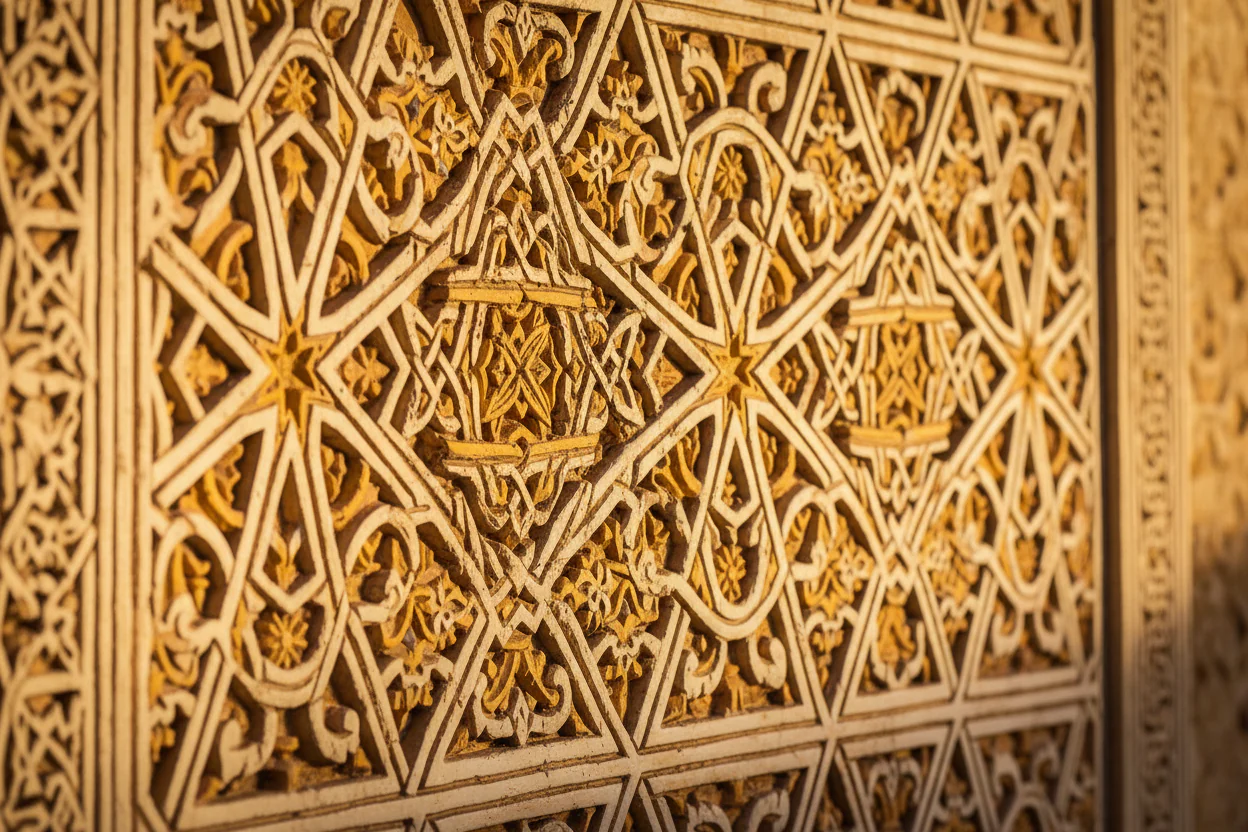
Look closely at the surface of an LSSAN bag. The patterns you see are not invented. They are borrowed — from the floors of Moroccan palaces, the carved plaster of ancient mosques, the zellige tilework of Fez and Tetouan. They are part of one of the most sophisticated visual traditions in human history: Islamic geometric art.
A Language Without Words
Islamic geometric art emerged in the 8th century as a way of expressing the infinite and the divine through mathematics and pattern. Unlike figurative art, which depicts the world as it appears, geometric art abstracts it — reducing the complexity of nature to its underlying structure: the circle, the polygon, the star.
The result is a visual language of extraordinary precision and beauty. A language that has been spoken in stone, tile, plaster, wood, and metal across the Islamic world for over a thousand years — and that now lives, pressed into leather, on the surface of every LSSAN bag.
The Motifs
The Star
The eight-pointed star — formed by overlapping two squares at 45 degrees — is one of the most fundamental forms in Islamic geometry. It appears in the zellige floors of the Bou Inania Madrasa in Fez, in the carved cedar ceilings of Tetouan’s historic houses, and in the hand-tooled leather of the LSSAN Stars collection. It is a symbol of order, harmony, and the infinite repetition of pattern.
The Heart
The Heart motif in the LSSAN collection draws from Moroccan folk tradition — a symbol of protection and love found in embroidery, pottery, and decorative craft across the country. In the context of the LSSAN bag, it is hand-embossed using the same metal stamps used for geometric patterns, giving it the same precision and depth as the more architectural motifs.
The Palm
The palm tree is one of Morocco’s most enduring natural symbols — present in the oases of the Draa Valley, the gardens of Marrakech, and the poetry of Moroccan literature. On the LSSAN bag, the Palm motif is a stylised interpretation of the tree’s fronds, hand-pressed into the leather in a repeating pattern that references both nature and the geometric tradition.
Tawriq — The Floral Scroll
Tawriq is the Arabic term for the flowing botanical scroll pattern found throughout Moroccan decorative art — in carved plaster, painted wood, and embroidered textiles. It is the tradition behind the Leafs motif in the LSSAN collection: organic, flowing, and rooted in the Andalusian decorative heritage that shaped northern Moroccan craft after the fall of Granada in 1492.
The Making
Every motif on an LSSAN bag is hand-embossed using traditional metal stamps — tools that have changed little in centuries. The leather is dampened, the stamp is positioned, and a single firm impression is made. Then the next. And the next. The process is slow, repetitive, and entirely human.
The artisans who do this work in Tetouan have learned their craft through apprenticeship — years of practice under a master craftsman before being trusted to work on a finished piece. The patterns they press into leather are the same patterns their teachers pressed, and their teachers before them.
This is what you carry when you carry an LSSAN bag: not just leather and laces, but a living tradition.
Explore the LSSAN Collection →